
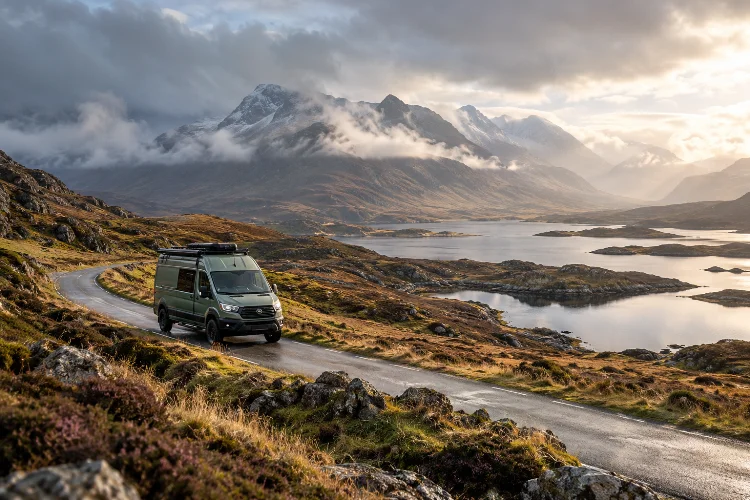
Picture yourself driving through the Scottish Highlands, surrounded by misty mountains, quiet lochs, and winding country roads.
Your campervan is fully equipped, your favourite playlist is running, and there’s no hotel check-in time controlling your adventure. Sounds pretty perfect, doesn’t it?
But here’s the thing: a successful overlanding trip across the United Kingdom involves more than following a beautiful route on Google Maps.
Narrow roads, unpredictable weather, complicated overnight parking rules, and remote landscapes can quickly turn an exciting journey into a stressful experience.
That’s where advanced UK overlanding route planning for adventure campervans becomes essential.
Unlike ordinary road trips, overlanding focuses on self-reliant travel, flexible itineraries, and exploring destinations beyond the usual tourist hotspots. It requires a balance between adventure, vehicle capability, logistics, and responsible travel.
Whether you’re exploring Scotland’s North Coast 500, the mountains of Wales, or England’s national parks, thoughtful preparation makes a massive difference.
In this guide, we’ll explore route selection, terrain assessment, navigation tools, campsite planning, weather strategies, and practical techniques for creating unforgettable UK campervan adventures.
1. Understanding the Fundamentals of UK Overlanding
Overlanding is often associated with remote deserts, rugged mountain tracks, and heavily modified four-wheel-drive vehicles.
However, the UK offers a different kind of adventure.
Instead of endless wilderness highways, you’ll encounter historic country lanes, coastal roads, national parks, rural villages, and occasional legally accessible unsurfaced routes.
The challenge isn’t necessarily finding the most extreme terrain. It’s connecting incredible landscapes while navigating the country’s unique road networks and land-access regulations.
Overlanding vs. Traditional Campervan Road Trips
A conventional campervan holiday might involve driving between established campsites and popular attractions.
Overlanding takes a more exploratory approach.
You might spend several days travelling through rural areas, adjusting your schedule around weather conditions, discovering quieter destinations, and relying on your vehicle for essential supplies.
That doesn’t automatically mean driving off-road.
In the UK, many excellent overland journeys follow public roads, with hiking, cycling, kayaking, or walking adventures taking place after the vehicle is safely parked.
This distinction is important because owning an off-road-capable campervan doesn’t give you permission to drive across protected countryside.
Establishing Your Travel Objectives
Before choosing a route, decide what kind of experience you’re looking for.
A photography-focused adventure might prioritize sunrise viewpoints and dramatic coastal scenery. Someone interested in hiking may prefer spending multiple nights near mountain trails.
For a longer expedition, reliable water access, vehicle maintenance opportunities, and comfortable overnight facilities become equally important.
Your planned route should reflect those priorities rather than simply connecting as many famous attractions as possible.
2. Choosing the Best UK Overlanding Routes for Campervans
The UK offers an impressive variety of landscapes within relatively manageable distances.
However, different regions present different driving conditions and logistical challenges.
Choosing a suitable route means understanding both the scenery and your campervan’s limitations.
Scotland’s North Coast 500
<text></text>
The <text></text>North Coast 500, often abbreviated as NC500, is one of Britain’s best-known scenic driving routes.
Starting and finishing in Inverness, the official route covers approximately 516 miles through the northern Highlands.
Expect dramatic coastlines, rugged mountains, remote communities, and plenty of opportunities for outdoor exploration.
It’s tempting to complete the entire circuit as quickly as possible, but rushing defeats much of the experience.
Allowing seven to ten days, or longer, creates more flexibility for photography, hiking, and changing weather.
One particularly important consideration is vehicle size.
The official NC500 guidance recommends alternative roads for larger motorhomes and specifically advises suitable drivers to avoid challenging sections such as Bealach na Bà and the B869 Drumbeg road when using larger vehicles.
A campervan-friendly itinerary should prioritize safe road access rather than assuming every scenic road is suitable.
Wales: Mountains and Coastal Adventures
Wales offers an excellent combination of mountainous landscapes and coastal exploration.
Eryri National Park, also known as Snowdonia, provides dramatic scenery, outdoor activities, and access to established touring facilities.
The nearby Llŷn Peninsula offers a different experience, featuring coastal villages, beaches, and walking routes.
A smart approach is to use a few well-positioned campsites as base camps.
You can then explore nearby trails without driving your campervan along every narrow rural road.
Visit Wales highlights how campsites and local railway connections can support campervan-based walking adventures in North Wales.
This approach reduces unnecessary driving while allowing more time outdoors.
England’s Lake District and Northern Ireland
The Lake District is another fantastic destination for adventure campervans.
Its mountain landscapes, lakes, and picturesque villages make it ideal for combining road travel with hiking and water activities.
However, some routes are extremely narrow and unsuitable for larger vehicles.
The official Lake District tourism website provides route-planning information and advice for campervan drivers.
Northern Ireland’s Causeway Coastal Route offers another worthwhile option, combining coastal scenery, historic landmarks, and accessible touring facilities.
For longer journeys, you could explore one region thoroughly instead of attempting to cover several countries in a single rushed trip.
3. Evaluating Road Conditions and Legal Vehicle Access
One of the most important skills in overlanding route planning is knowing whether a particular road is actually suitable for your vehicle.
A route that looks straightforward on a digital map can become considerably more challenging in real life.
Steep gradients, narrow bridges, tight corners, and limited turning areas can create problems for larger campervans.
Understanding Vehicle Dimensions and Road Restrictions
Before travelling, record your vehicle’s overall height, width, length, and loaded weight.
Remember to include roof racks, solar panels, bicycle carriers, and other accessories.
These measurements help you identify potential restrictions before reaching them.
For example, a road passing beneath a low stone bridge might be perfectly suitable for a compact campervan but impossible for a high-roof conversion.
Vehicle weight matters too.
Some rural bridges have weight limits, while steep mountain roads may place additional demands on braking and cooling systems.
Always follow posted restrictions and check your vehicle’s permitted operating limits.
UK driving licence requirements also depend on the vehicle’s maximum authorised mass, so drivers of heavier motorhomes should verify their entitlement before departure.
Understanding Green Lanes and Byways
Green laning can be part of an overlanding experience, but legality must come before adventure.
In England and Wales, a Byway Open to All Traffic, or BOAT, is a public right of way that can permit motor vehicles.
Restricted byways, footpaths, and bridleways generally do not provide equivalent public motor-vehicle rights.
Even a BOAT may be affected by a Traffic Regulation Order restricting vehicle access.
Use the relevant local authority’s definitive map and current restriction information to verify a route.
Also consider whether the surface is appropriate for your campervan.
A legally accessible byway isn’t necessarily suitable for a heavy, long-wheelbase vehicle with limited ground clearance.
Driving responsibly means avoiding damage to sensitive ground and turning back when conditions become unsafe.
Navigating Single-Track Roads
Single-track roads are common in parts of rural Scotland.
They require patience, confidence, and an understanding of passing places.
Drivers may occasionally need to reverse to a suitable passing point so another vehicle can pass.
Never use passing places as overnight parking spots or scenic picnic stops.
They’re essential parts of the road network, particularly for local residents, delivery vehicles, and emergency services.
If you’re uncomfortable reversing your vehicle along a narrow road, choose an alternative route.
There’s absolutely nothing wrong with taking the easier road when it improves safety.
4. Planning Around UK Weather and Seasonal Conditions
UK weather can change surprisingly quickly.
You might start the morning enjoying sunshine beside a peaceful lake and finish the afternoon driving through heavy rain and strong winds.
For adventure campervans, weather affects much more than personal comfort.
It influences visibility, road conditions, available daylight, and access to remote areas.
Choosing the Right Travel Season
Spring can be a fantastic time for quieter roads and emerging landscapes.
However, temperatures can remain low, particularly in northern Scotland and higher mountain areas.
Summer generally provides longer daylight hours, making it attractive for extended outdoor activities.
The downside is increased demand for campsites, parking facilities, and popular attractions.
Autumn offers beautiful colours and potentially quieter destinations, although shorter days and deteriorating weather require careful scheduling.
Winter overlanding can be rewarding for experienced travellers, but snow, ice, storms, and road closures create additional risks.
For many first-time UK overlanders, late spring or early autumn can offer a useful compromise between accessibility and visitor numbers.
Building Weather Flexibility Into Your Route
Advanced route planning shouldn’t depend on perfect conditions.
Instead, create alternative activities and driving routes for days when the weather changes.
For example, a planned mountain hike might become a relaxed village exploration if strong winds make higher ground unsafe.
The Met Office publishes specialist mountain forecasts covering several popular UK regions.
These provide useful information about conditions that ordinary town-level forecasts may not fully capture.
Check the forecast before setting off and review it again on the day.
Keep a backup route available offline, particularly when heading into remote Highland areas where mobile reception can be inconsistent.
That extra preparation may save your trip from an unecessary detour.
5. Finding Legal Overnight Parking and Responsible Campsites
Finding somewhere to sleep is one of the biggest practical challenges of a UK campervan expedition.
Unlike some countries with extensive remote camping opportunities, UK overnight vehicle parking rules vary considerably between locations.
A beautiful roadside viewpoint doesn’t automatically become a legal campsite once the sun goes down.
Understanding Wild Camping Regulations
Scotland is famous for its outdoor access rights.
However, there’s an important distinction between lightweight tent camping and sleeping overnight in a campervan.
The Scottish Outdoor Access Code allows responsible lightweight camping in tents where access rights apply, subject to relevant restrictions.
Those rights do not extend to motor vehicles.
Campervan parking is governed by applicable road, parking, landownership, and local regulations.
In England and Wales, camping on land generally requires appropriate permission unless a specific legal right or arrangement applies.
The safest approach is to use authorised campsites, designated motorhome stopovers, or private land where the owner has explicitly permitted your stay.
Always check local signage and restrictions rather than relying entirely on crowdsourced parking recommendations.
Planning Overnight Stops Strategically
A reliable itinerary identifies potential overnight locations before the day’s driving begins.
Ideally, you’ll have a primary campsite and a reasonable alternative.
During busy holiday periods, advance reservations can be particularly useful around popular destinations.
Check whether a site accepts your vehicle dimensions, provides suitable facilities, and remains open during your travel dates.
Some smaller sites operate seasonally or have limited arrival hours.
It’s also helpful to research whether each stop provides electricity, fresh water, toilets, and wastewater disposal.
A well-positioned campsite can function as a logistics hub rather than simply somewhere to sleep.
Practising Low-Impact Overlanding
Responsible overlanding protects the landscapes you’re travelling to enjoy.
Dispose of chemical toilet waste only at facilities intended for that purpose.
Never empty grey water into streams, roadside drains, or sensitive natural environments.
Keep noise low, respect private property, and avoid blocking entrances or access roads.
If you arrive somewhere and discover that overnight parking isn’t permitted, move to an authorised location.
Supporting local campsites, shops, and services also helps rural communities benefit from adventure tourism.
6. Using Navigation Technology and Building Realistic Itineraries
Technology has made route planning significantly easier.
However, relying on a single navigation app can still create problems.
A more dependable approach combines digital mapping, appropriate vehicle routing, offline navigation, and local road information.
Combining Digital Maps and Offline Navigation
Google Maps is useful for estimating distances, finding services, and understanding general road connections.
However, ordinary car-routing settings may not account for your campervan’s dimensions or all rural access restrictions.
Specialist motorhome navigation tools can help when they support vehicle-specific height, width, and weight profiles.
Ordnance Survey mapping is valuable for understanding terrain, public rights of way, and walking opportunities.
For remote adventures, download maps before leaving areas with reliable internet access.
Keep important campsite addresses, emergency contacts, and alternative routes accessible without mobile data.
If you’re using multiple mapping tools, compare their recommendations instead of assuming the shortest route is always the best.
Calculating Realistic Daily Driving Distances
One common mistake is planning too many miles per day.
A 100-mile journey on a motorway is completely different from travelling the same distance on narrow Highland roads.
Slower speeds, passing places, viewpoints, and scenic detours all increase journey time.
For example, consider a hypothetical 90-mile rural route with an average moving speed of 30 mph.
The basic calculation gives three hours of driving.
Add two photography stops, a lunch break, and a short walk, and the journey could easily occupy five or six hours.
That’s why realistic itinerary planning should consider activities rather than mileage alone.
An example five-day regional schedule might include one arrival day, two exploration days, one flexible weather day, and a final departure day.
This creates breathing room without turning the holiday into a strict timetable.
Creating Alternative Route Options
An advanced trip plan should include at least one alternative for important journey sections.
Consider what happens if a mountain pass closes, a campsite becomes unavailable, or a mechanical issue delays your departure.
Save alternative roads seperately so they’re easy to identify.
You can also organize destinations into priority categories.
Must-see locations deserve space in the schedule, while optional attractions can be skipped when necessary.
This flexible approach helps preserve the freedom that makes overlanding enjoyable in the first place.
7. Managing Fuel, Supplies, Vehicle Readiness, and Emergency Planning
Remote travel involves more logistical thinking than ordinary city driving.
Fuel stations, supermarkets, repair facilities, and mobile coverage may be farther apart than expected.
A well-equipped campervan provides independence, but good planning determines how effectively you use it.
Estimating Fuel and Water Requirements
Start with your vehicle’s real-world fuel consumption rather than relying exclusively on manufacturer figures.
Imagine your campervan averages 28 miles per gallon using UK imperial gallons.
For a hypothetical 500-mile journey, estimated consumption would be:
500 ÷ 28 = 17.9 imperial gallons
That equals approximately 81 litres of fuel.
The actual amount may increase when travelling through mountainous terrain or carrying a heavier load.
Keep a sensible fuel reserve and identify potential refuelling points along remote routes.
Water requirements deserve similar attention.
A couple using 15 litres of water per person daily would need approximately 90 litres for three days without replenishment.
That’s a planning example, not a universal consumption figure.
Drinking, cooking, washing, and shower habits significantly influence actual demand.
Preparing Your Adventure Campervan
Before departure, inspect tyres, fluid levels, brakes, lights, and essential safety equipment.
Check that heavy luggage and removable interior components are securely restrained.
A breakdown kit, suitable spare-wheel equipment, first-aid supplies, and weather-appropriate clothing can be valuable during remote journeys.
Also consider your electrical system.
Solar panels may perform differently under prolonged cloud cover, so battery capacity should be matched to realistic energy consumption.
If you plan to work remotely, identify places where internet access is likely to be availble instead of assuming reliable coverage everywhere.
Developing an Emergency Strategy
Even experienced overlanders encounter unexpected setbacks.
Mechanical problems, severe weather, and temporary road closures can disrupt carefully prepared plans.
Share your general itinerary with someone you trust, particularly before exploring remote regions.
Store essential emergency numbers and relevant breakdown-assistance information offline.
In the UK, 999 and 112 are emergency numbers for police, fire, and ambulance services.
If poor weather or road conditions make a route unsafe, postpone that section rather than taking unnecessary risks.
A flexible calender and a realistic emergency budget can make these situations far easier to manage.
The best adventures often happen when you’re prepared enough to change your plans.
Advanced UK overlanding route planning for adventure campervans is about finding the perfect balance between exploration, safety, and flexibility.
From selecting scenic destinations and evaluating road conditions to understanding overnight parking regulations, every planning decision contributes to a better travel experience.
The UK offers incredible opportunities for campervan adventures, whether you’re exploring the Scottish Highlands, discovering the Welsh coastline, or travelling through England’s beautiful national parks.
The secret is to avoid rushing, understand your vehicle’s limitations, and always respect local communities and natural environments.
Good navigation tools, weather awareness, and sensible preparation allow you to enjoy the freedom of overlanding without unnecessary complications.
Ready for your next adventure? Choose your favourite UK region, build a flexible campervan itinerary, and start planning a journey that combines unforgettable scenery with smart, responsible exploration.
