

Imagine waking up beside a remote mountain lake, brewing fresh coffee, and enjoying complete freedom without worrying about electricity, accommodation, or the next charging station. That’s the appeal of modern adventure travel on four wheels.
But building a reliable expedition vehicle requires much more than installing a comfortable bed and a rooftop solar panel.
Advanced Adventure Vans combine intelligent conversion engineering, energy management, practical interior design, and carefully planned off-grid systems.
Whether you’re exploring isolated mountain routes or planning extended cross-country journeys, understanding the technology behind these vehicles can make travelling safer, more comfortable, and considerably more sustainable.
1. Understanding Advanced Adventure Van Engineering
Modern camper conversions have evolved from basic recreational vehicles into sophisticated mobile living systems.
Today’s expedition-oriented builds integrate structural engineering, electrical technology, water management, thermal insulation, and digital monitoring.
The challenge is making these systems function reliably within a relatively small vehicle.
Defining the Purpose of an Expedition Van
Before selecting equipment or designing an interior, builders should identify how the vehicle will actually be used.
A van intended for weekend camping requires a different configuration from one designed for months of remote travel.
Some travellers prioritise paved-road comfort and convenient campsite access. Others need improved traction, substantial water reserves, and durable components capable of handling rough conditions.
These requirements influence everything from chassis selection to battery capacity.
For example, a couple working remotely may need reliable connectivity, a dedicated workspace, and substantial electrical storage.
An outdoor sports enthusiast might instead prioritise bicycle storage, accessible equipment compartments, and easily cleaned interior surfaces.
There is no universal perfect conversion. The strongest designs begin with clearly defined travel requirements.
Selecting the Right Vehicle Platform
Popular conversion platforms include the Mercedes-Benz Sprinter, Ford Transit, and Ram ProMaster, alongside regional alternatives.
Each offers different advantages in cargo dimensions, drivetrain configurations, service availability, and conversion flexibility.
A taller roof may improve interior comfort, while a shorter wheelbase can make manoeuvring through narrow roads easier.
Payload capacity deserves particular attention.
The total weight of cabinetry, batteries, water, passengers, tools, and expedition equipment must remain within the vehicle’s permitted limits.
Manufacturers also specify restrictions involving structural modifications, mounting points, electrical integration, and vehicle dimensions.
Ignoring these requirements can create serious safety problems.
2. Advanced Van Conversion Design and Structural Optimisation
A professional conversion must balance usable space, durability, safety, and mechanical performance.
Making the interior attractive is relatively easy compared with creating a layout that remains functional after thousands of kilometres of vibration and changing environmental conditions.
Optimising Weight Distribution and Payload
Weight distribution directly influences handling, braking, tyre loading, and suspension behaviour.
Heavy equipment should generally be secured low and positioned to maintain appropriate front-to-rear and side-to-side axle loading.
Battery banks, water tanks, and storage systems require particular attention.
A poorly planned conversion might overload one axle even when the total vehicle weight remains below the maximum permitted gross vehicle weight.
Consider a hypothetical van with 1,400 kilograms of available payload before conversion.
Its expected additional loads might include:
| Component | Estimated Weight |
|---|---|
| Furniture and Insulation | 250 kg |
| Electrical System | 130 kg |
| Water and Plumbing | 170 kg |
| Kitchen Equipment | 70 kg |
| Passengers and Personal Gear | 250 kg |
| Expedition Accessories | 180 kg |
| Total Added Load | 1,050 kg |
This illustrative calculation leaves 350 kilograms of apparent payload capacity.
However, builders must confirm actual installed weights, the vehicle’s as-built rating, and individual axle loads.
The safest approach is to weigh the completed vehicle in realistic travel condition and compare the results with manufacturer specifications.
Structural Reinforcement and Secure Mounting
Conversion components experience constant vibration, temperature changes, and movement.
Cabinetry and equipment should be attached using suitable mounting structures rather than relying on ordinary furniture fasteners.
Builders must also consider crash loads.
An unsecured battery or water tank can become extremely dangerous during sudden braking or a collision.
Structural modifications, including additional windows, roof openings, and seat installations, should follow manufacturer guidance and applicable regulations.
Professional assessment is particularly important when changes affect crash structures, seating restraints, or load-bearing components.
Designing Flexible Interior Spaces
Limited interior space encourages multifunctional design.
A dining area may transform into a sleeping arrangement, while seating compartments can provide additional storage.
However, clever design should not come at the expense of everyday convenience.
For example, a bed that requires extensive rearrangement every evening may become frustrating during longer journeys.
Experienced van builders prioritise layouts that support realistic daily activities.
Good interior engineering makes ordinary routines simple, even when the vehicle is parked in challenging conditions.
3. Off-Grid Electrical Systems and Solar Power Engineering
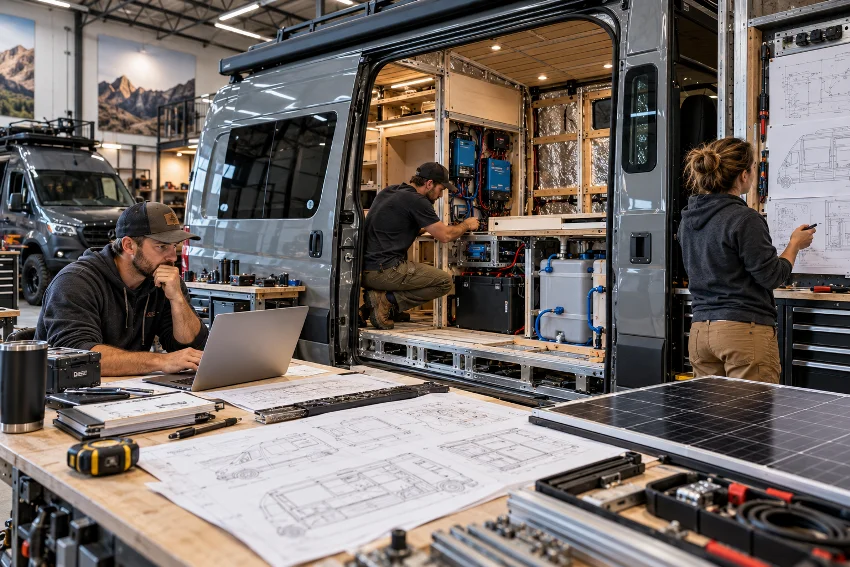
Electrical independence is one of the defining features of advanced camper conversions.
Refrigeration, lighting, communication devices, water pumps, ventilation, and computing equipment all require dependable power.
A properly designed system should support these demands without unnecessary complexity.
Calculating Daily Electrical Consumption
Before choosing batteries or solar panels, builders need an energy budget.
Daily electricity consumption is calculated by multiplying each appliance’s power usage by its operating time.
For example:
| Electrical Equipment | Daily Consumption |
|---|---|
| Efficient Refrigerator | 400 Wh |
| LED Lighting | 80 Wh |
| Laptop and Electronics | 300 Wh |
| Ventilation Fan | 120 Wh |
| Water Pump | 40 Wh |
| Communication Equipment | 60 Wh |
| Total | 1,000 Wh |
These figures are illustrative and will vary with equipment efficiency, ambient temperature, and actual usage.
The calculation suggests a typical requirement of approximately 1 kWh per day for this particular setup.
However, actual planning should also account for system losses, additional appliances, and emergency reserves.
Lithium Batteries and Energy Storage
Lithium iron phosphate batteries, commonly called LiFePO4 batteries, are popular for mobile electrical systems.
They offer useful cycle-life characteristics, relatively stable voltage, and efficient storage compared with many traditional battery technologies.
However, batteries still require suitable protection, charging controls, temperature management, and appropriate installation.
For example, a nominal 12.8-volt, 200-amp-hour battery stores approximately 2,560 watt-hours of energy.
That doesn’t mean every watt-hour is available under all operating conditions.
Usable energy depends on the battery’s permitted operating range, system efficiency, temperature, and manufacturer limits.
Builders should select capacity based on realistic consumption and desired autonomy.
Solar Charging and Power Management
Rooftop solar panels can help replenish batteries during daylight.
However, solar performance changes according to weather, season, shading, panel orientation, and geographic location.
A 400-watt array receiving four equivalent peak-sun hours could theoretically generate 1,600 watt-hours before system losses.
Actual production will be lower when conversion losses, heat, shading, and other operating conditions are considered.
A solar charge controller regulates energy transferred from panels to the battery system.
Victron Energy explains that batteries should not be connected directly to solar panels without an appropriate charge controller.
Advanced systems may also use alternator charging through a suitable DC-DC charger and shore-power charging when available.
These additional charging options reduce dependence on favourable weather.
Electrical design, cable sizing, overcurrent protection, and grounding should be reviewed by qualified professionals familiar with mobile installations.
4. Water Storage, Plumbing, and Off-Grid Resource Management
Electricity isn’t the only resource that limits remote travel.
Fresh water often determines how long travellers can comfortably remain away from established facilities.
Advanced plumbing systems focus on storage efficiency, sanitation, reliability, and straightforward maintenance.
Designing a Practical Freshwater System
A typical conversion may include a freshwater tank, pump, distribution lines, sink, filtration equipment, and optional shower.
Tank capacity should match the number of travellers and expected consumption.
For example, two people using approximately 15 litres each per day would consume 90 litres over three days.
This is only an illustrative planning scenario.
Actual water requirements increase significantly when frequent showers, laundry, pets, or additional cooking activities are involved.
Builders should also remember that every litre of water adds approximately one kilogram of weight.
A 100-litre full tank therefore adds roughly 100 kilograms before accounting for the tank and associated equipment.
Greywater and Waste Management
Greywater is wastewater generated by activities such as washing dishes and using a sink.
It should be collected and disposed of according to local regulations and environmental requirements.
Discharging wastewater onto the ground can damage sensitive environments and may be prohibited.
A practical installation allows waste tanks to be inspected, cleaned, and emptied without complicated disassembly.
Accessible plumbing connections also make leak detection easier.
For remote travel, simplicity often delivers greater reliability than elaborate systems containing numerous hidden fittings.
Filtration and Water Quality
Remote travellers sometimes need to obtain water from unfamiliar sources.
However, clear-looking water isn’t necessarily safe to drink.
Appropriate treatment depends on the potential presence of sediment, microorganisms, and chemical contaminants.
A sediment filter alone does not reliably eliminate waterborne pathogens.
Travellers should use suitable treatment methods supported by manufacturer guidance and reliable public-health recommendations.
Maintaining separate awareness of potable and non-potable water is essential.
Good water management involves protecting water quality throughout storage, not just during initial collection.
5. Thermal Insulation, Ventilation, and Climate Control
Maintaining comfortable interior temperatures is a major challenge in mobile living.
A metal vehicle body responds quickly to external temperature changes.
Without proper design, occupants may experience excessive heat, cold surfaces, condensation, and poor air quality.
Managing Insulation and Thermal Bridges
Insulation reduces heat transfer, but the material alone doesn’t determine performance.
Installation quality, air leakage, window area, and structural thermal bridges all matter.
Metal ribs and exposed structural components can transfer heat even when surrounding cavities contain insulation.
Builders should select appropriate materials based on moisture behaviour, fire performance, weight, and installation requirements.
More insulation isn’t always better if it prevents surfaces from drying or creates hidden moisture problems.
A well-designed system considers the complete vehicle envelope.
Ventilation and Moisture Control
Cooking, breathing, and wet clothing introduce moisture into a small interior.
When humid air contacts colder surfaces, condensation may develop.
Roof ventilation fans, appropriately positioned vents, and controlled airflow can help reduce moisture accumulation.
However, ventilation does not eliminate every condensation problem.
Thermal bridges, leaks, and poorly installed insulation may still cause difficulties.
Monitoring interior humidity and inspecting concealed areas periodically helps identify problems before serious damage occurs.
Heating and Cooling for Remote Conditions
Climate control requirements depend heavily on the destination.
Cold-weather travellers may consider properly installed externally vented heating systems suitable for vehicle use.
Hot-weather travellers should evaluate shading, ventilation, window insulation, and the electrical demands of air conditioning.
Air conditioning can consume significantly more electricity than basic lighting or refrigeration.
This makes prolonged battery-powered cooling challenging without substantial energy storage and recharging capacity.
Combustion appliances require special caution.
Never use portable camping stoves, charcoal grills, or generators inside a van. Follow appliance-specific installation and ventilation rules, and install appropriate carbon monoxide detection.
Reliable comfort starts with safe engineering rather than improvisation.
6. Expedition Vehicle Performance and Off-Road Preparation
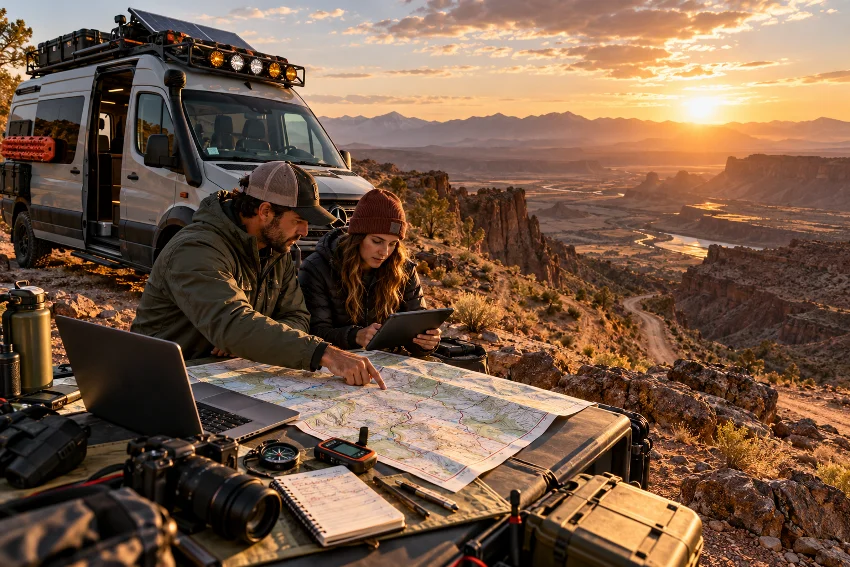
An attractive camper interior means little if the vehicle cannot safely reach its intended destination.
Expedition planning requires understanding mechanical limitations, driving conditions, vehicle loading, and maintenance requirements.
Suspension, Tyres, and Ground Clearance
Travellers often consider suspension upgrades or more aggressive tyres when preparing for challenging roads.
However, modifications should address genuine operating needs.
A suspension lift may improve some clearance measurements while also changing handling characteristics and vehicle height.
Larger tyres can influence gearing, speedometer accuracy, braking behaviour, and clearance.
Any changes should remain compatible with manufacturer limits and local regulations.
Tyre selection should consider expected surfaces, load ratings, durability, and seasonal conditions.
For many journeys, suitable tyres and responsible driving technique offer more practical value than extreme modifications.
Mechanical Reliability and Preventive Maintenance
Remote travel exposes existing mechanical weaknesses.
Before departure, owners should inspect brakes, tyres, steering components, suspension, cooling systems, and fluid levels.
Maintenance intervals should reflect manufacturer recommendations and actual operating conditions.
Carrying basic tools and selected spare components can improve preparedness.
However, travellers should understand which repairs they can competently perform and which require professional assistance.
A reliable vehicle is generally more valuable than one equipped with numerous complicated accessories.
Recovery Equipment and Route Limitations
Recovery equipment may be useful when travelling away from paved roads.
However, equipment selection must account for vehicle weight, rated attachment points, terrain, and the dangers associated with recovery forces.
Improvised towing connections can fail violently.
Travellers unfamiliar with vehicle recovery should obtain practical instruction rather than relying on online demonstrations.
The smartest expedition decision is sometimes choosing a safer route instead of attempting an obstacle beyond the vehicle’s capabilities.
7. Advanced Expedition Planning and Remote Travel Logistics
Successful expeditions depend on far more than navigation.
Weather, energy availability, water supply, fuel consumption, road access, and communication all influence the journey.
Planning these factors together improves both safety and flexibility.
Building a Realistic Expedition Route
A good itinerary considers road conditions, expected travel speeds, available services, and alternative destinations.
Distance alone rarely predicts travel time on remote routes.
A 150-kilometre journey over maintained highways may be straightforward, while the same distance on rough mountain roads can demand considerably more preparation.
Offline navigation tools are useful where mobile coverage is unreliable.
Travellers should also maintain access to appropriate paper maps or independent navigation alternatives.
Route information must be checked against current closures, access restrictions, and weather conditions.
Calculating Fuel, Water, and Energy Autonomy
Resource autonomy describes how long a vehicle can operate without replenishment.
It should be calculated separately for fuel, water, and electricity.
For example, a vehicle carrying 75 litres of usable fuel and consuming 12 litres per 100 kilometres has a theoretical range of approximately 625 kilometres.
Actual range may be lower because of terrain, vehicle loading, weather, idling, and driving conditions.
Travellers should preserve a contingency reserve rather than planning to use every litre.
The same principle applies to batteries and water supplies.
An expedition is only as flexible as its most restrictive essential resource.
Emergency Communication and Preparedness
Remote travel may involve limited cellular coverage.
Satellite communication devices, emergency location services, and offline navigation can improve preparedness.
Travellers should share route details and expected check-in times with a trusted contact.
Emergency supplies should include first-aid materials, suitable clothing, additional drinking water, and essential vehicle equipment.
Weather changes and mechanical problems can extend journeys unexpectedly.
The objective isn’t to eliminate every uncertainty, which is impossible, but to develop sensible responses to foreseeable problems.
8. Smart Van Technology and Long-Term Ownership Strategy
Advanced mobile systems increasingly include digital monitoring, connected electronics, and integrated controls.
These tools provide valuable information, but their complexity must be justified by practical benefits.
Monitoring Vehicle Systems Digitally
Modern electrical systems may provide real-time information about battery state of charge, solar generation, and energy consumption.
Digital dashboards can help travellers recognise unusual patterns before critical resources run low.
For example, unexpected overnight battery discharge might indicate an appliance malfunction or an overlooked electrical load.
Water-level monitoring and temperature sensors can provide additional operational awareness.
However, important systems should remain usable when displays, wireless networks, or communication devices fail.
A sensible design preserves essential manual controls.
Maintenance and Lifecycle Cost Planning
Conversion costs don’t end when the vehicle is completed.
Batteries, tyres, suspension components, plumbing fittings, and electrical equipment all require inspection or eventual replacement.
Owners should maintain service records and document important installation details.
A professional electrical diagram can make future maintenance considerably easier.
Likewise, clearly labelled plumbing and accessible service panels reduce troubleshooting time.
The strongest conversions prioritise maintenance access from the beginning.
Balancing Technology With Simplicity
It’s tempting to equip an expedition van with every available smart feature.
However, additional complexity can introduce more potential failure points.
A sophisticated automation system may offer convenience, but travellers should consider whether it provides meaningful benefits over simpler alternatives.
Remote journeys often reward durability, repairability, and straightforward operation.
The ideal vehicle is not necessarily the one with the most technology.
It’s the one that consistently supports its owner’s actual travel goals.
Building reliable Adventure Vans requires thoughtful conversion engineering, efficient off-grid systems, responsible vehicle preparation, and realistic expedition planning.
The best designs balance comfort, safety, independence, and long-term maintainability without unnecessary complexity.
Before starting your next conversion, evaluate your travel requirements, calculate essential resources, and develop a practical engineering plan. Build intelligently today, and enjoy greater freedom on tomorrow’s adventures.
Expand your knowledge by exploring additional resources connected to the topics discussed in this article. Discover informative references, consider fresh perspectives, and investigate related subjects at your own pace. Continuing your research can help develop a broader understanding and encourage more informed exploration.