
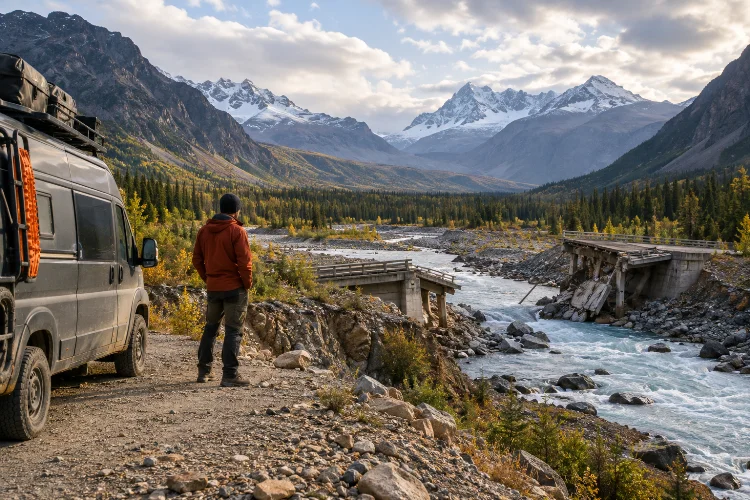
Imagine driving your campervan through a remote mountain valley, surrounded by incredible scenery, when suddenly you notice the fuel gauge dropping faster than expected.
The nearest petrol station is miles away, mobile reception is disappearing, and your carefully planned adventure starts feeling a little stressful.
Not exactly the off-grid freedom you had in mind, right?
That’s why understanding fuel consumption and travel range is essential for any serious campervan expedition.
Optimising campervan expedition routes for fuel and range limits isn’t simply about finding the shortest road between two destinations. It’s about balancing vehicle efficiency, terrain conditions, fuel availability, driving habits, and realistic safety margins.
Unlike ordinary road trips, overlanding adventures often involve remote landscapes, steep mountain passes, unpredictable weather, and long distances between services.
A poorly planned route can quickly become expensive, inconvenient, or even dangerous.
Fortunately, a few smart calculations and practical planning strategies can make a huge difference.
In this guide, we’ll explore how to estimate your campervan’s real-world range, choose efficient routes, organise refuelling stops, and build flexible expedition plans that help you travel further with confidence.
1. Understanding Your Campervan’s Real-World Fuel Consumption
Before planning a long-distance expedition, you need to understand how much fuel your vehicle actually uses.
That might sound obvious, but many campervan owners rely entirely on manufacturer fuel economy figures.
The problem? Those numbers don’t always reflect real adventure travel.
A fully loaded campervan travelling through mountainous terrain can behave very differently from an empty vehicle driving on a relatively flat motorway.
Calculating Your Actual Fuel Economy
The easiest way to estimate fuel consumption is to record how much fuel your vehicle uses over several journeys.
Start with a full tank, reset your trip meter, and drive normally until your next refuelling stop.
Then record the amount of fuel needed to refill the tank and the distance travelled.
For example, imagine your campervan travels 450 kilometres and uses 49.5 litres of diesel.
Your consumption calculation becomes:
Fuel Consumption = (Fuel Used ÷ Distance Travelled) × 100
(49.5 ÷ 450) × 100 = 11 L/100 km
This means your vehicle consumes approximately 11 litres for every 100 kilometres under those conditions.
If you prefer miles per gallon, make sure you’re using the correct conversion. UK imperial gallons and US gallons have different volumes.
Why One Fuel Economy Figure Isn’t Enough
A single average can be misleading.
Your vehicle might achieve relatively good fuel efficiency on highways but consume significantly more fuel during steep climbs or slow, technical driving.
That’s why experienced overlanders benefit from recording several consumption figures.
For example, keep seperate records for motorway travel, rural roads, mountainous routes, and challenging unpaved tracks.
Over time, you’ll develop a more realistic understanding of your vehicle’s performance.
This information becomes especially useful when planning adventures through regions where petrol stations are difficult to find.
2. Calculating Safe Driving Range and Fuel Reserves
Knowing your average fuel consumption is only half the equation.
You also need to calculate how far your vehicle can travel before refuelling becomes necessary.
The important distinction is between theoretical maximum range and practical expedition range.
These numbers should never be treated as identical.
Calculating Maximum Fuel Range
Let’s imagine your campervan has a usable fuel tank capacity of 70 litres and normally consumes 11 L/100 km.
Your theoretical range would be:
Maximum Range = (Tank Capacity ÷ Fuel Consumption) × 100
(70 ÷ 11) × 100 = approximately 636 km
Under those specific conditions, the vehicle could theoretically travel around 636 kilometres.
However, planning to drive until the tank is almost empty would be risky during remote travel.
Traffic delays, unexpected detours, headwinds, and rough terrain can all increase fuel consumption.
A sensible expedition plan should include a reserve that remains available for emergencies.
Building a Practical Fuel Reserve
Instead of planning around your entire tank capacity, establish a minimum fuel reserve appropriate to your route.
For this example, suppose you choose to retain 15 litres.
That leaves 55 litres available for planned travel.
At 11 L/100 km, your planned range becomes:
(55 ÷ 11) × 100 = 500 km
Now imagine the terrain becomes more demanding and consumption increases to 14 L/100 km.
Your range drops to approximately 393 kilometres.
<text></text>
| Driving Scenario | Consumption | Planned Range |
|---|---|---|
| Normal Road Conditions | 11 L/100 km | 500 km |
| Mixed Expedition Terrain | 12.5 L/100 km | 440 km |
| Demanding Terrain | 14 L/100 km | 393 km |
These figures assume 55 litres available for planned driving and are illustrative rather than guaranteed predictions.
Notice how dramatically the travel distance changes.
A route that looks manageable under normal conditions might become unsuitable when driving through mountains or difficult terrain.
The best strategy is to calculate range using a conservative consumption estimate and treat the reserve as protection against uncertainty.
For particularly remote expeditions, additional contingency planning may be necessary.
3. Choosing Routes Based on Terrain and Energy Efficiency
The shortest route isn’t always the most fuel-efficient.
A winding mountain road might cover fewer kilometres than a major highway, yet require considerably more fuel because of steep gradients and repeated acceleration.
Understanding how terrain affects consumption helps you compare routes more intelligently.
Evaluating Elevation Changes
Climbing hills requires energy because the engine must lift the vehicle against gravity.
Heavier campervans need more energy to gain the same elevation.
Although descending may recover some energy in hybrid or electric vehicles, conventional diesel and petrol campervans cannot generally recover most of the energy spent climbing.
Descending also introduces braking and vehicle-control considerations.
For expedition planning, look beyond total distance and examine the route’s elevation profile.
A 150-kilometre route crossing several mountain passes may be more demanding than a 190-kilometre route following gentler terrain.
That doesn’t mean you should always avoid mountain roads.
Sometimes the scenery and adventure are worth the additional fuel.
The key is recognising the trade-off before making your decision.
Comparing Two Expedition Routes
Consider two hypothetical routes connecting the same destinations.
Route A follows a winding mountain road for 260 kilometres, with estimated fuel consumption of 13 L/100 km.
Route B follows a longer but smoother road for 320 kilometres, averaging 9 L/100 km.
The estimated fuel requirements would be:
Route A: 260 × 13 ÷ 100 = 33.8 litres
Route B: 320 × 9 ÷ 100 = 28.8 litres
Despite being 60 kilometres longer, Route B uses approximately five litres less fuel.
These figures aren’t universal predictions, but they demonstrate why route efficiency shouldn’t be judged by distance alone.
Traffic, average speed, road quality, and vehicle characteristics all influence the final result.
Accounting for Surface Conditions
Unpaved roads introduce additional variables.
Loose gravel, deep sand, mud, and uneven surfaces can increase rolling resistance and place greater demands on the drivetrain.
Slow off-road driving may also involve frequent gear changes and extended periods of low-speed engine operation.
Before including challenging tracks in your itinerary, check their legal accessibility and suitability for your vehicle.
An ordinary two-wheel-drive campervan may not be appropriate for routes requiring high-clearance four-wheel-drive equipment.
If conditions become questionable, selecting an alternative route is usually smarter than pushing deeper into unfamiliar terrain.
4. Planning Fuel Stops Along Remote Expedition Routes
Finding reliable refuelling opportunities is one of the most important parts of long-distance campervan route planning.
In populated areas, fuel stations are rarely a major concern.
Remote regions are different.
Some locations have significant distances between fuel suppliers, and individual stations may operate limited hours or experience temporary shortages.
Identifying Reliable Refuelling Locations
Begin by marking potential fuel stations along your intended route.
Digital mapping platforms can help identify locations, but they shouldn’t be your only source of information.
Check whether each station provides the fuel type your vehicle requires.
For example, a station might supply petrol but not the diesel grade you need.
Opening hours also matter.
A remote filling station may close early or operate differently during weekends and public holidays.
Contacting remote suppliers before departure can help confirm availability, although conditions may still change.
Avoid assuming that a station displayed on an online map is currently operational.
Using Refuelling Checkpoints
A practical expedition plan uses designated refuelling checkpoints rather than waiting until the fuel warning light appears.
Suppose your conservative planned range is 390 kilometres.
You might select fuel stops approximately 200–250 kilometres apart when reliable facilities are available.
This provides room for unexpected detours without relying on the entire available range.
However, the ideal interval depends on route conditions, fuel availability, and the reliability of each stop.
For remote regions, your fuel strategy should include a primary supplier and a realistic alternative.
Check whether reaching that alternative would require backtracking.
Remember that an out-and-back detour consumes fuel in both directions.
Carrying Additional Fuel Safely
Some expeditions may require supplementary fuel capacity.
However, carrying spare petrol or diesel introduces additional safety and legal considerations.
Only use containers specifically approved for the fuel being transported.
They must be properly sealed, secured, protected from damage, and carried in accordance with applicable regulations and vehicle requirements.
Petrol vapours are especially hazardous, so fuel should not be casually stored inside occupied campervan living spaces.
Before adding auxiliary tanks or external fuel containers, consider vehicle payload, mounting strength, ventilation, and local transport rules.
For many journeys, choosing a better route with reliable refuelling opportunities is simpler than carrying extra fuel.
5. Improving Campervan Efficiency Through Weight and Driving Habits
Even the best-planned route can become expensive if your vehicle isn’t operating efficiently.
Fortunately, there are several practical ways to reduce fuel consumption without making your adventure less enjoyable.
Most involve managing vehicle weight, improving aerodynamics, and adopting smoother driving habits.
Reducing Unnecessary Expedition Weight
Adventure campervans often carry an impressive amount of equipment.
Camping furniture, recovery gear, additional batteries, spare parts, water containers, and outdoor equipment can quickly add substantial weight.
Every additional kilogram increases the load your vehicle must move.
That doesn’t mean removing essential safety equipment to save fuel.
Instead, focus on identifying unnecessary items and choosing equipment that serves multiple purposes.
For example, lightweight storage modules can be more practical than permanently installed heavy cabinetry.
Water also contributes considerably to vehicle weight.
A 100-litre freshwater supply weighs approximately 100 kilograms before accounting for the tank and associated equipment.
Carry enough water for safe travel, but consider whether reliable refill locations could reduce unnecessary excess load on less remote sections.
Managing Aerodynamic Drag
Rooftop equipment can influence fuel consumption, especially at higher driving speeds.
Roof boxes, large storage containers, and poorly positioned accessories increase aerodynamic resistance.
According to the US Department of Energy’s fuel economy guidance, a large, blunt rooftop cargo box can reduce fuel economy by approximately 6–17% during highway driving in the studied vehicle conditions.
That doesn’t mean every campervan roof rack causes the same reduction.
Actual effects depend on the vehicle, accessory design, and driving speed.
However, reducing unnecessary external equipment is a sensible efficiency strategy.
Low-profile accessories and well-planned equipment placement may help improve overall aerodynamics.
Adopting Fuel-Efficient Driving Techniques
Smooth driving can make a meaningful difference over long distances.
Avoid unnecessary hard acceleration and braking, maintain appropriate following distances, and anticipate changes in traffic.
Research summarised by the US Department of Energy indicates that aggressive driving can substantially reduce fuel economy, although the exact impact varies.
Maintaining a steady, legal speed is generally more efficient than repeatedly accelerating and slowing down.
Cruise control can help on suitable roads, but it may not always be appropriate on steep or slippery terrain.
Correct tyre pressure is equally important.
Check pressures when tyres are cold and follow the vehicle manufacturer’s recommendations for the loaded vehicle.
Avoid exceeding speed limits or using unsafe driving techniques simply to improve fuel efficiency.
6. Using Navigation Technology and Weather Forecasts to Extend Range
Modern navigation technology has made expedition planning much more manageable.
However, a navigation app that displays the fastest route doesn’t necessarily identify the most fuel-efficient option for a fully loaded campervan.
Combining several planning tools gives you a better understanding of potential challenges.
Choosing Navigation Tools Wisely
Google Maps is useful for comparing distances, estimated travel times, and nearby services.
Specialist motorhome navigation software may offer additional options for vehicle height, width, weight, and road restrictions.
For off-grid trips, offline mapping is especially valuable.
Download the relevant maps before entering areas where mobile reception may be unreliable.
Topographic mapping can also help identify steep gradients, mountain passes, and remote access roads.
Where possible, compare estimated travel time with the route’s elevation profile and road surface information.
A slightly longer route with reliable fuel stations and fewer challenging sections might be the more dependable choice.
Understanding Weather-Related Fuel Consumption
Weather can influence vehicle efficiency in several ways.
Strong headwinds increase aerodynamic resistance, particularly for tall campervans with large frontal areas.
Cold temperatures can increase fuel consumption through longer engine warm-up periods and additional heating demands.
Heavy rain, snow, and muddy surfaces may also increase resistance or require slower driving.
Before entering remote terrain, review reliable weather forecasts and current road conditions.
If severe weather is expected, consider postponing the journey or choosing an alternative route.
That extra preparation can prevent an avoidable fuel shortage and keep your expedition safer.
Making Route Adjustments During Travel
Advanced planning doesn’t mean following an itinerary regardless of changing circumstances.
Imagine discovering that a remote fuel station is closed.
Instead of continuing and hoping another supplier appears, recalculate your available range using the remaining fuel and realistic conditions.
If the nearest confirmed supplier lies beyond your safe range, return to a known location while you still have sufficient fuel.
Keep alternative roads and refuelling options saved seperately in your navigation system.
The ability to change plans confidently is an essential overlanding skill.
7. Building a Practical Fuel-Conscious Expedition Plan
The most effective campervan journeys combine calculations, logistics, and flexible decision-making.
Rather than relying on intuition, create a simple planning process you can repeat before every expedition.
You don’t need expensive software to get started.
A spreadsheet, offline maps, and accurate fuel consumption records are often enough to develop a dependable system.
Creating a Route Planning Worksheet
Begin by recording the distance between major destinations.
Then add the expected driving conditions, estimated fuel consumption, and available refuelling locations.
For example, a hypothetical expedition could include three stages.
The first involves 180 kilometres of relatively easy road driving.
The second covers 140 kilometres of mountainous terrain.
The final stage includes 110 kilometres of rural roads leading to the next reliable fuel supplier.
Assume your estimated fuel consumption is 10, 14, and 11 litres per 100 kilometres, respectively.
Your predicted consumption becomes:
| Expedition Stage | Distance | Estimated Fuel |
|---|---|---|
| Highway Travel | 180 km | 18 L |
| Mountain Terrain | 140 km | 19.6 L |
| Rural Roads | 110 km | 12.1 L |
| Total | 430 km | 49.7 L |
For a vehicle with a 70-litre usable tank, the example leaves an estimated 20.3 litres after the journey.
However, that doesn’t automatically make the route safe.
Your calculations must still account for fuel reserves, uncertain consumption, possible closures, and unexpected detours.
The calcluation should be revisited whenever actual conditions differ from your assumptions.
Monitoring Performance During the Expedition
Once you’re on the road, compare actual fuel consumption with your original estimates.
Modern trip computers can provide useful information, although manual fuel records offer an additional way to check accuracy.
If consumption increases unexpectedly, investigate possible causes.
Strong winds, additional weight, low tyre pressure, and changing terrain are potential explanations.
Mechanical issues can also affect efficiency.
Don’t ignore warning lights or unusual vehicle behaviour merely because the destination seems close.
Update your expected remaining range after each refuelling stop and before entering a remote section.
Preparing for Unexpected Delays
Remote expedition planning should always include emergency preparation.
Carry sufficient drinking water, food, appropriate clothing, basic tools, and communication equipment for the conditions.
Where mobile coverage is unreliable, a suitable satellite communication device may be worth considering.
Inform someone you trust about your intended route and expected check-in time.
The US National Park Service recommends carrying detailed maps, checking road conditions, and preparing for delayed assistance when travelling in remote areas.
If your vehicle becomes immobilised, follow local emergency guidance and avoid leaving it without a safe, informed plan.
A well-prepared expedition isn’t about eliminating every possible problem.
It’s about making sure unexpected challenges don’t become emergencies simply becuase fuel, supplies, or route alternatives weren’t considered.
Optimising campervan expedition routes for fuel and range limits is one of the smartest ways to make long-distance adventures safer, more economical, and more enjoyable.
By understanding real-world fuel consumption, calculating conservative driving ranges, evaluating terrain, and planning reliable refuelling stops, you can reduce uncertainty before entering remote areas.
Vehicle weight, driving habits, weather conditions, and navigation technology also influence how far your campervan can travel.
The goal isn’t necessarily to drive the fewest kilometres or achieve the absolute lowest fuel consumption. It’s to create a practical route that balances efficiency, safety, and memorable experiences.
With thoughtful preparation, even challenging journeys become easier to manage.
Ready to plan your next campervan expedition? Start tracking your fuel economy, calculate a realistic range, and build an adventure route that gives you freedom without unnecessary fuel worries.
